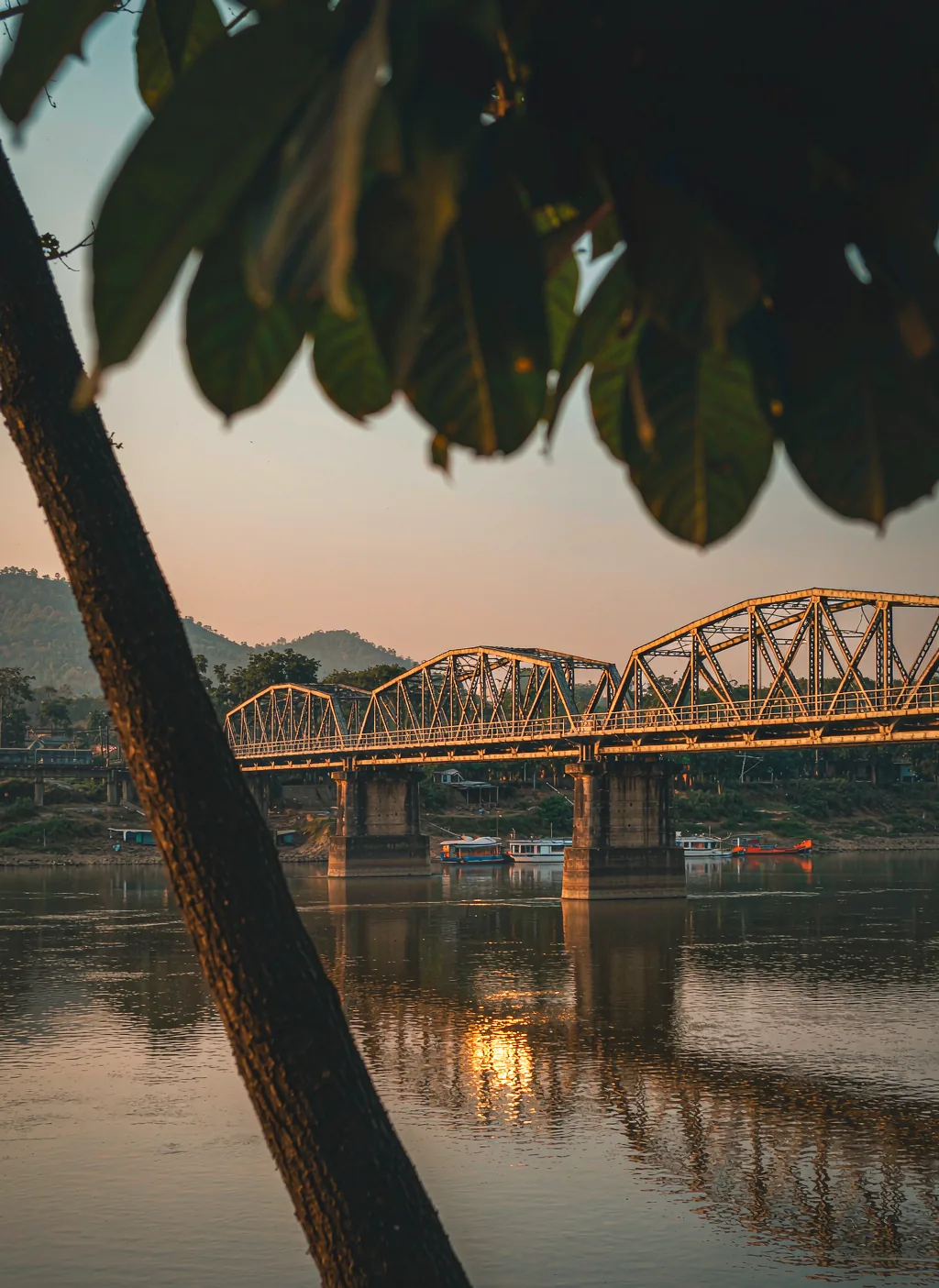
The Bridge on the River Kwai
The steel bridge built by Allied prisoners of war and Asian labourers under the Japanese army, and the railway that followed it.
The Bridge on the River Kwai is in Kanchanaburi, 130km west of Bangkok, built by Allied prisoners of war and Asian labourers under Japanese occupation in 1942–43. Visiting is free; the JEATH War Museum costs 150 baht. Allow two to three hours.
Open The Bridge on the River Kwai in Google Maps14.0417, 99.5033
Prices and hours are our current best information, not a published rate. Confirm on the day before you travel.
The steel bridge built by Allied prisoners of war and Asian labourers under the Japanese army, and the railway that followed it.
The bridge was part of the Burma Railway, a 415km line built through jungle and mountains to supply Japanese forces in Burma. Around 12,000 Allied prisoners and up to 90,000 Southeast Asian labourers died on the line, mostly of disease, starvation and exhaustion. The bridge was bombed by the Allies in 1945 and rebuilt; the curved spans in the middle are original, the straight ones are replacements.
The history matters and the setting is beautiful, which makes it a place that needs handling with care. A guide who knows the facts turns a photo stop into the most memorable hour of the trip.
What you’ll actually see
- The bridge itself, and the difference between the original curved spans and the rebuilt ones
- The JEATH War Museum, built in a replica POW camp, with photographs and letters
- The Thailand–Burma Railway Centre, the best-curated museum on the subject
- The war cemeteries at Kanchanaburi and Chungkai, maintained by the Commonwealth War Graves Commission
How to visit it well
- Ride the train over the Tham Krasae viaduct — the wooden section is the dramatic part.
- Visit the war cemetery in town; it is immaculately kept.
- Go early; the bridge is crowded by 10am.
Mistakes worth avoiding
- Only doing the bridge and the 'Death Railway' train ride without visiting a museum
- Treating it as a photo stop — the history requires an hour of reading
- Missing Hellfire Pass, 80km further up the line, which is the more affecting site
Is it worth it?
Worth a full day, and the museums are the reason. The bridge by itself is underwhelming without context; with the railway centre and Hellfire Pass it becomes one of the most important days you can spend in Thailand.
Common questions
Bus or minivan from Mo Chit takes 2.5 hours. The train from Thonburi is slower but crosses the bridge itself, which is the point.
Yes, there is a walkway between the rails. It is free and open all day.
Yes for the Tham Krasae section, where the track runs along a cliff above the river. Sit on the left going up.
Two days: one for the bridge, museums and cemetery, one for Erawan Falls and Hellfire Pass.
Tours that include The Bridge on the River Kwai
Related experiences
Last updated: October 2026 · Prices and hours checked by Tom Whitfield